Immunisation
Giving What We Can no longer conducts our own research into charities and cause areas. Instead, we’re relying on the work of organisations including J-PAL, GiveWell, and the Open Philanthropy Project, which are in a better position to provide more comprehensive research coverage.
These research reports represent our thinking as of late 2016, and much of the information will be relevant for making decisions about how to donate as effectively as possible. However we are not updating them and the information may therefore be out of date.
Immunisations against a range of major diseases from hepatitis to influenza can be highly cost-effective because they are easily administered and accessible to the neediest of populations. However, there is significant variation among immunisation approaches, and most charities do not focus on the most cost-effective of these.
Immunisation is the process whereby a person is made immune or resistant to an infectious disease, typically by the administration of a vaccine. Vaccines stimulate the body's own immune system to protect the person against subsequent infection or disease.
Immunisation is a proven tool for controlling and eliminating life-threatening infectious diseases and it is estimated to avert over 2 million deaths each year. It is one of the most cost-effective health interventions, with proven strategies that make it accessible to even the most remote and vulnerable populations. It has clearly defined target groups, it can be delivered effectively through outreach activities, and vaccination does not require any major lifestyle changes.[1]
COST-EFFECTIVENESS
Intuitively, immunisations would seem likely to be a highly cost-effective intervention. Indeed, the WHO claim, “Immunisation is … one of the most cost-effective health investments.” [1] Immunisations are also recommended by the Copenhagen Consensus.
However, the results of the DCP2 and WHO-CHOICE reports suggest that though some immunisation interventions are cost-effective, the majority are much less cost-effective.
We have been unable to source comprehensive cost-effectiveness estimates from charities focussing on immunisation. The exceptions are the Measles Initiative, which estimates that a single vaccination for measles costs less than $1, and the Global Polio Eradication Initiative, which estimates that a single vaccination for polio costs $0.08.
The DCP2 and WHO-CHOICE cost-effectiveness estimates are as follows:
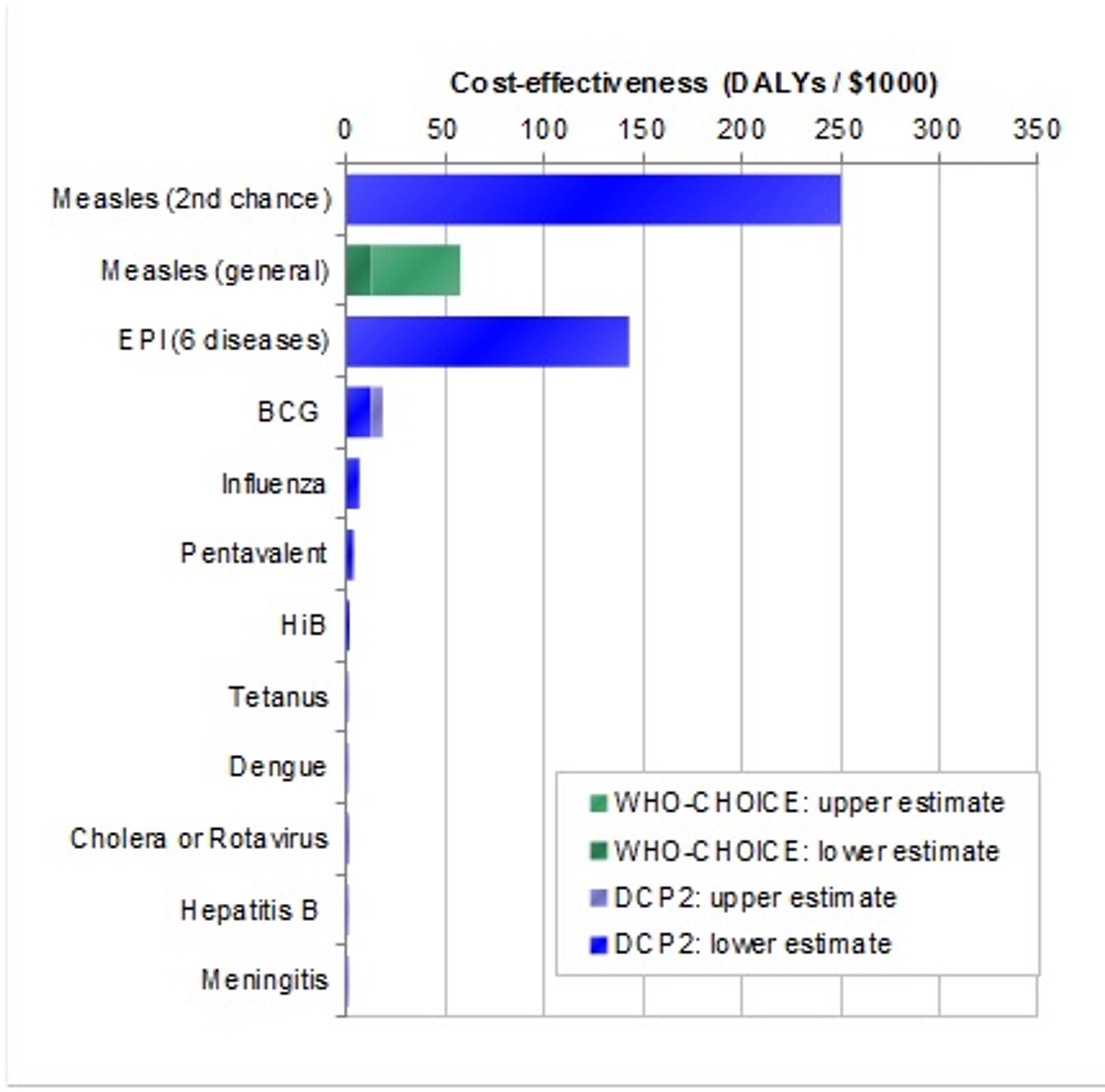
In understanding the DCP2 figures, it is important to note the contrast in cost-effectiveness between the pentavalent vaccine, the expanded programme (EPI) and the measles vaccine. The pentavalent vaccine consists of five vaccine treatments: Haemophilus influenzae type B (Hib), hepatitis B, diphtheria, pertussis (whooping cough), and tetanus. The EPI programme consists of diphtheria, tetanus, pertussis, polio, measles, and the BCG. The pentavalent vaccine and the EPI programme treat very similar diseases; however, only the latter includes measles treatment. It is therefore likely that in the expanded programme, it is the vaccination against measles that is responsible for the majority of its cost-effectiveness.
Another point to note is that DCP2's measles cost-effectiveness estimate may be optimistic, as the number of cases has been declining rapidly since this report, which suggests that the cost-effectiveness of this treatment will similarly decrease.
Note that the DCP2 estimate for measles vaccination includes the benefit of providing a centralised clinic for a 'second chance' vaccination. In other words, people who missed the opportunity to be vaccinated in their own villages can travel to these clinics and still get vaccinated. According to the DCP2 report, this is a particularly effective method, with each $1,000 preventing 250 Disability Adjusted Life Years, which is roughly on a par with saving 8 lives. The WHO-CHOICE estimate (which doesn't specify whether second chance vaccination is included) is that each $1,000 spent on measles vaccination saves around 30 DALYs, or the equivalent of 1 life.
Other information
Are there side-effects?
All health interventions have side-effects, both good and bad.
Some of the positive side-effects of immunisation include:
- Vaccination does not require any major lifestyle changes, and there is very little cost to the recipient in terms of travel costs and working hours lost.
- Vaccinations have economic and social benefits, as these diseases can severely impair people’s ability to work and care for their families.
One negative side-effect is:
- Some of the vaccinations have (very small) risks of medical side-effects.
Conclusion
It is important to know which immunisations specific charities are providing. Many do not focus merely on the traditional expanded programme but also fund pentavalent vaccination programmes, thereby dividing their funding between highly cost-effective and much less cost-effective interventions. We have yet to find a charity that focusses solely on the most cost-effective vaccinations.
In general, we don't have sufficient evidence that immunisation programmes, as they are currently carried out by charities, are cost-effective enough for us to recommend them.
Sources:
Last updated: in or before 2012